[Neurocomputing 2026] A Low-Burden Attention Network Based on Asynchronous Mechanism for BCI Motor Intention Recognition
Abstract
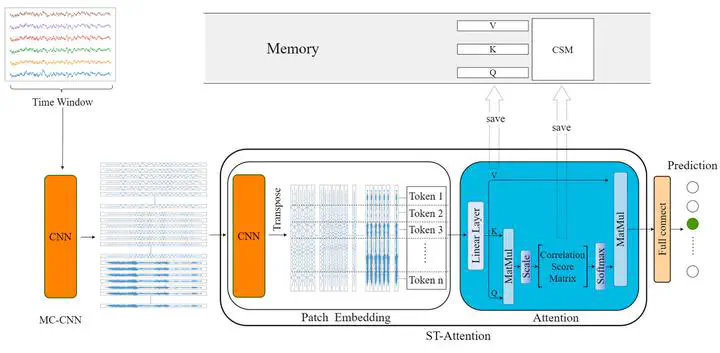
Motor Intention recognition based on Electroencephalogram (EEG) signals has received substantial attention in the pattern recognition due to its rich neural information and independent acquisition methods. Many deep learning-based methods have been used to process EEG data to recognize human motor intentions. Although these methods have achieved good classification accuracy, Convolutional Neural Network (CNN)-based methods struggle to balance local and global features due to their limited perceptual field. Additionally, mainstream attention-based models compute pairwise interactions among all patches in the time window to capture global dependencies, which significantly wastes computational resources. To address the above problems, we propose an Asynchronous Spatial-Temporal Attention Network (AsyncST-Atten), which first extracts local features through shallow convolutions and then applies attention mechanisms to model their long-range temporal dependencies. Most importantly, we introduce a novel EEG signal–stream processing paradigm that extends the standard attention mechanism to operate on an ‘evolving’ time window, enabling efficient incremental updates. Within this processing paradigm, our approach can update the inference results for the entire time window by computing only the newly arrived EEG signals within the current window, thereby significantly reducing computational load and latency for EEG processing. Through extensive experiments on two publicly available motor imagery datasets, AsyncST-Atten achieves up to an eight-fold reduction in computational complexity (FLOPs) while maintaining comparable or superior accuracy to state-of-the-art models. This reduction in computation burden directly translates to a 2-fold reduction in computational latency when compared to other methods based on synchronous mechanism, offering a practical solution for low-burden and high-speed processing of EEG data.

Zhenliang Zhang
Research Scientist of AI
My research interests include wearable computing, machine learning, Cognitive Reasoning, and mixed/virtual reality.